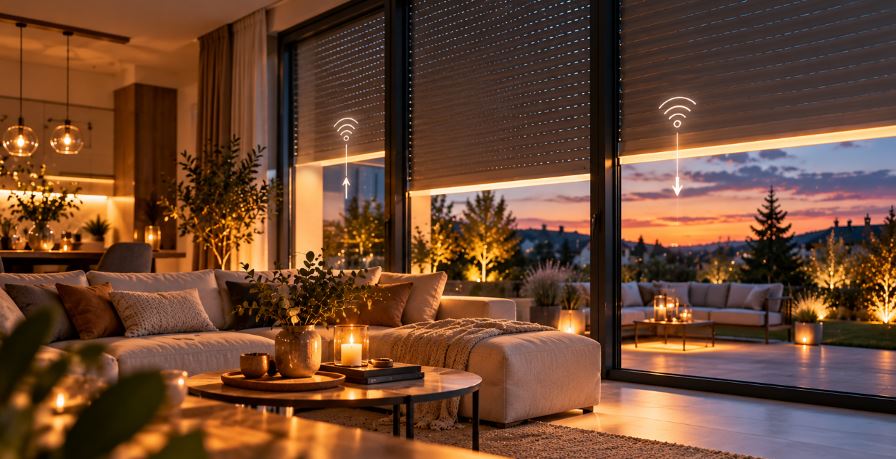
Imagine a morning when you wake up to natural light instead of the sound of an alarm clock. At a set time, the roller shutters in your bedroom slowly rise, letting in the first rays of sunlight. In the evening, the opposite happens – after sunset, the shutters automatically lower, providing privacy for everyone in the house.
Just a few years ago, solutions like these were associated mainly with futuristic, luxury homes. Today, automatic roller shutters can be a practical part of a smart home, and the range of options for controlling them continues to grow. Their greatest advantage, however, is not simply the “wow” factor, but the convenience they bring to everyday life.
Instead of raising and lowering the shutters on several or even a dozen windows every morning and evening, you can programme them to operate according to the household’s daily routine. At weekends, the bedroom shutters can open later than they do from Monday to Friday, while those in the living room can close automatically in the evening.
This is a good example of what a smart home should be in practice – technology that does not make life more complicated but takes care of repetitive everyday tasks for us.
Smartphone, remote control or schedule – how can roller shutters be controlled?
Automatic roller shutters are equipped with a motor that allows the shutter curtain to be raised and lowered without any physical effort. The method of operation, however, depends on the solution you choose.
The simplest option is a wall switch or remote control. More advanced systems allow you to operate the shutters using a smartphone app, create schedules or group several shutters together. This means that with a single command, you can close all the shutters on the ground floor, for example, or only those in the bedrooms.
Things become even more interesting when the shutters are integrated into a smart home system. You can then create predefined scenarios for specific situations. A “good night” scene could lower the shutters throughout the house, while a “good morning” scene could gradually raise them. When everyone leaves the house, the system could also close selected shutters while carrying out other programmed actions.
Depending on the system, voice control or integration with other smart home devices may also be possible. However, it is worth remembering that the range of available functions depends on the type of motor, control unit and compatibility of the individual devices. This is why it is best to consider how you want to control your shutters when choosing them.
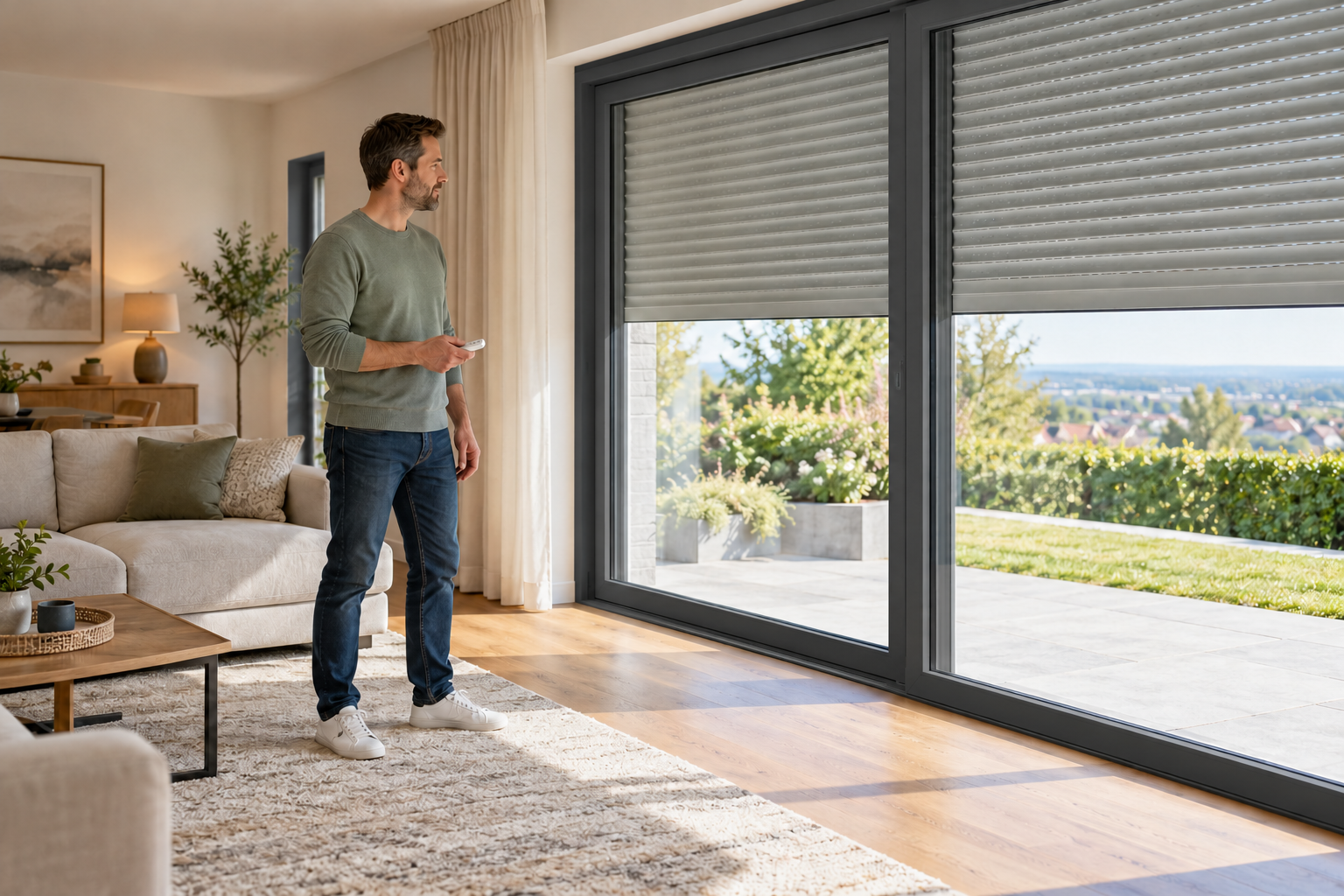
Remote-controlled roller blinds
Check out our range of external roller blinds:
Automatic roller shutters can respond to sunlight and temperature
The real potential of automation becomes apparent when the shutters no longer wait for a command from the user but respond automatically to specific conditions.
A hot, sunny day is a good example. Large glazed areas are an attractive feature of modern homes and provide plenty of natural light, but they can also cause interiors to heat up considerably. In a properly designed system, roller shutters can work with sunlight or temperature sensors and lower before the room becomes excessively warm.
Instead of returning home in the evening to an overheated living room, the shutters can be used to limit solar heat gain during the day.
In winter, the system can operate in a completely different way. During sunny hours, the shutters can remain open to make use of natural light, while after dark they can be lowered. Automation therefore allows the operation of the shutters to be adapted not only to the time of day but also to current conditions.
This is where smart roller shutters stop being merely a gadget and begin to serve a practical purpose in managing comfort inside the building. A properly configured system can respond to changing conditions without requiring constant attention from the household.
Away from home? Your roller shutters can still follow their schedule
Almost everyone knows the feeling of leaving for work or going away for the weekend and suddenly wondering: “Did I close the roller shutters?” With traditional controls, the only options are to go back or accept that they will remain in the same position for several days.
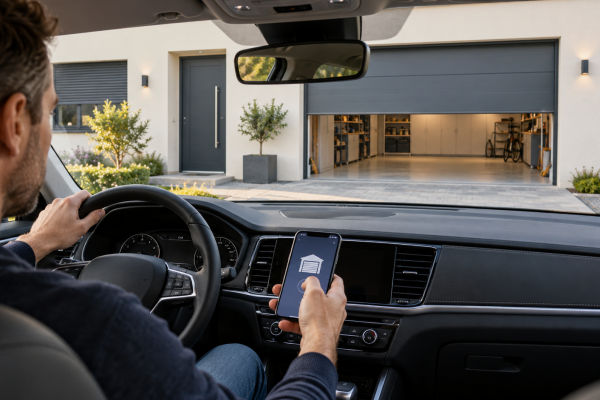
If the system provides remote access, the shutters can also be controlled while you are away from home. Using an app, you can change their position or activate a previously prepared scenario.
Schedules can also be useful during longer periods away from home. The shutters can open in the morning and close in the evening, meaning that the building does not remain in exactly the same state throughout your absence.
Automation, however, is not only convenient when you are on holiday. Its advantages are often most noticeable in larger homes. If you have a dozen or more roller shutters, manually operating each one every day can quickly become another household chore. Being able to close all the shutters with a single button, from your smartphone or automatically at a specific time makes the process significantly easier.
This solution is also useful for windows in hard-to-reach locations, where manual operation of the shutters would simply be inconvenient.
Is it worth investing in automatic roller shutters?
The answer depends primarily on the building and the expectations of its occupants. With just one or two small windows, traditional controls may be perfectly sufficient. However, the more glazed areas there are, the greater the potential benefits of automation.
Group control, schedules, remote operation and integration with a smart home system can make roller shutters an integral part of a modern home.
It is also worth remembering that automation does not mean having to use your phone every time you want to cover a window. Quite the opposite – a well-designed system should reduce the need to reach for an app. If the shutters lower automatically in the evening, respond to intense sunlight and rise in the morning according to a set schedule, the user only needs to intervene when they want something different from the usual routine.
It is best to consider automation when choosing your windows, doors and shading solutions so that the motors, power supply and control method can all be properly planned in advance.
At Aikon Distribution, we help select window, door and shading solutions tailored to the specific needs of each project. Because a smart home should not impress with the number of apps and buttons it has. It should make certain everyday tasks happen automatically – exactly when you need them to.
Read also: