Window parameters tell a buyer about quality, performance and safety. They should be easy to read, no matter which country the windows are bought in or exported to.
Window parameters on the US market and in Europe do not always match, even when the names look similar. Below are the main European figures and their US counterparts.
Do window parameters in the US and Europe differ?
Window and door production in both Europe and the United States follows norms meant to keep quality, performance and safety high. Those rules are set out in coefficients, test methods and specifications.
Some values look almost identical at first glance, but they are defined or calculated differently. One reason is the unit system: the US uses imperial units, Europe the metric system.
The other reason is who sets the rules: in Europe, ISO and European Norms; in the US, NFRC window ratings (National Fenestration Rating Council) and NAFS (North American Fenestration Standard).
These bodies rate windows and doors for energy efficiency and test heat transfer and solar transmission.
Basic window parameters in Europe and the United States
U-value vs Uw: heat transfer coefficient
The lower the heat transfer coefficient, the better the window keeps heat in.
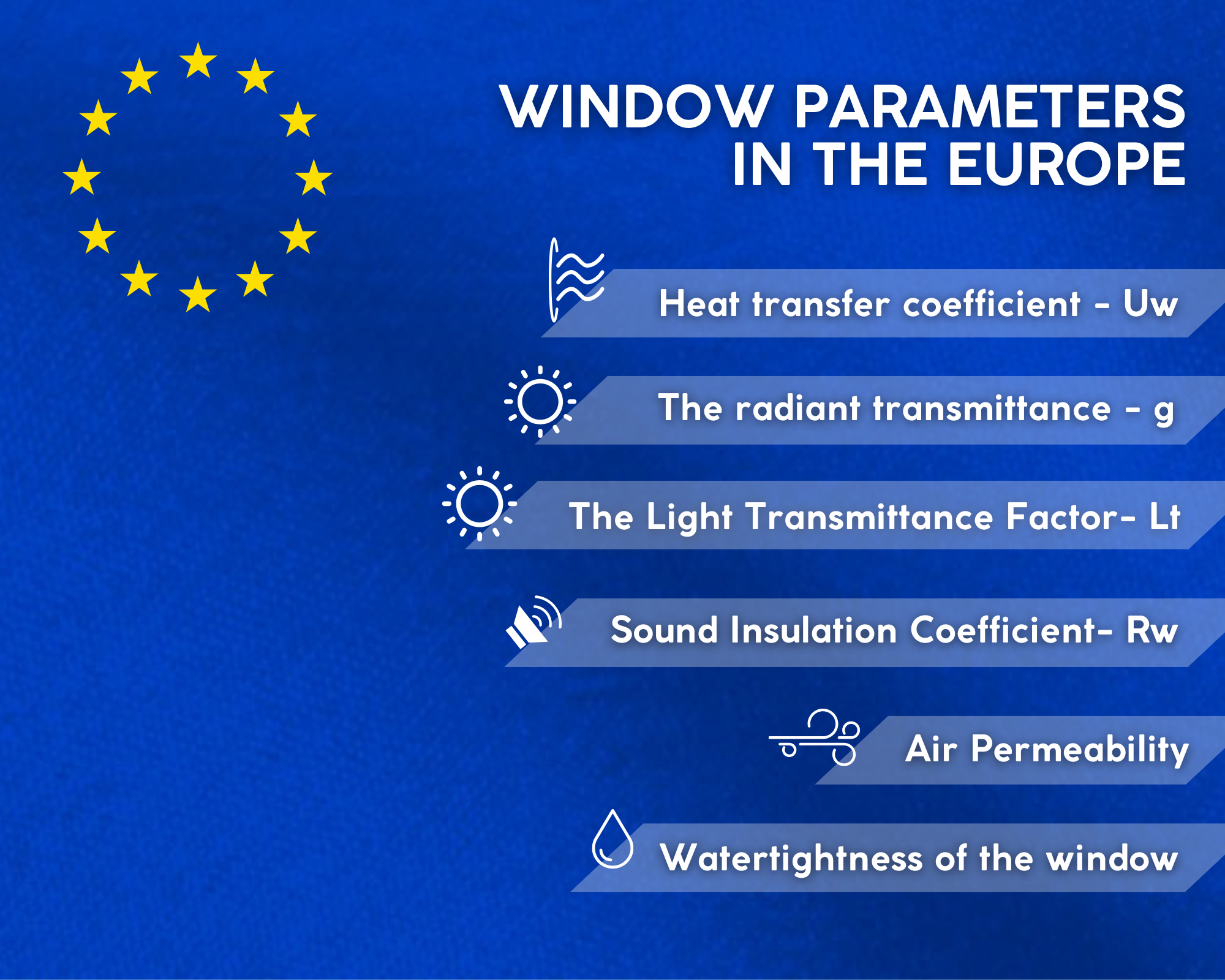
In Europe the symbol is Uw. It describes how much heat (energy) can pass through 1 m² of a flat surface — wall, roof, window or door — when the temperature difference between the two sides is 1 kelvin. Uw is expressed in watts per square metre per kelvin (W/m²·K).
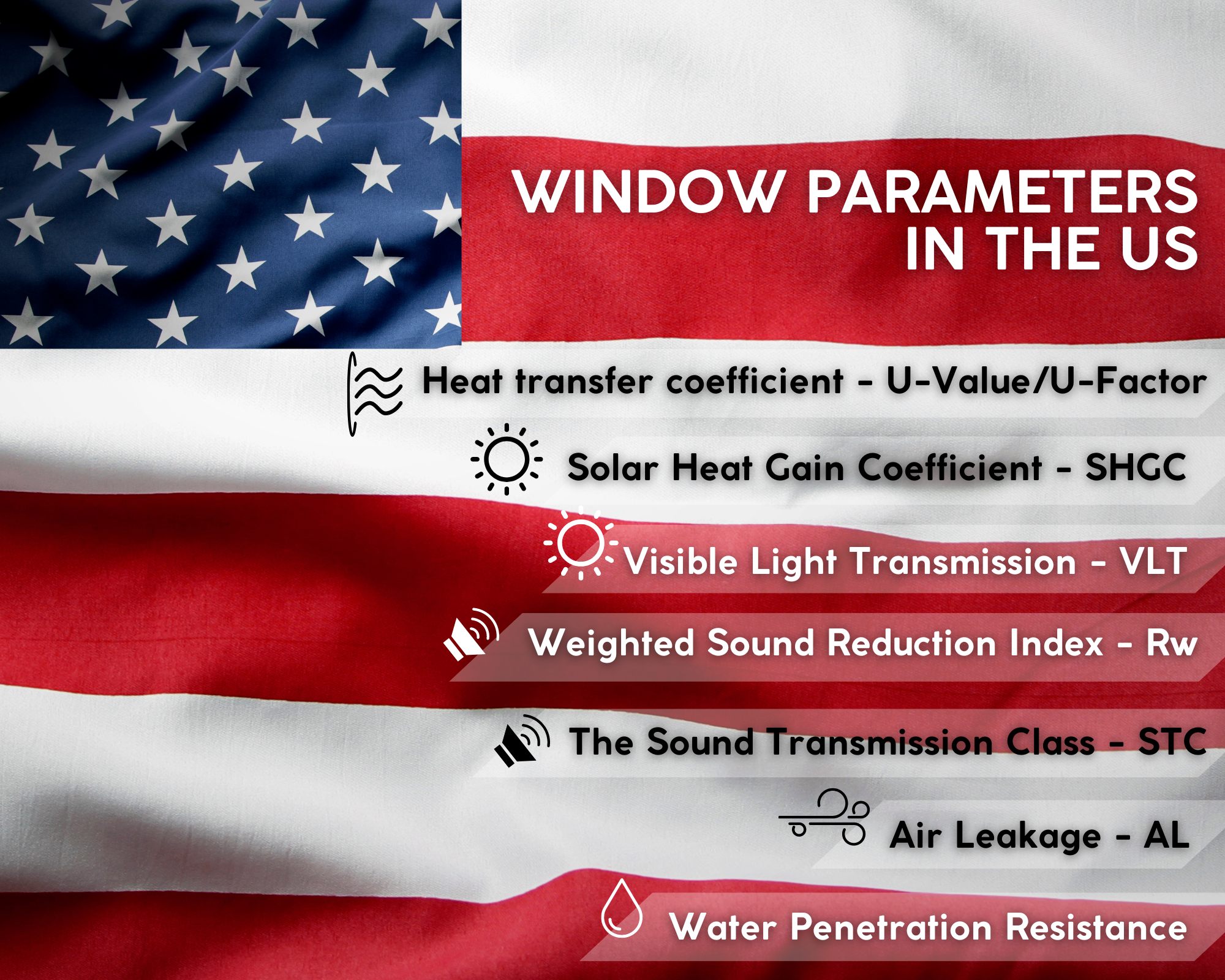
The US counterpart of Uw is U-value (also called U-factor), given in Btu/(h·ft²·°F). When you compare U-value vs Uw on windows, remember the units as well as the number: a lower figure still means better insulation in both systems.
Window parameters in Europe
Parameters related to solar radiation
In Europe there are two coefficients for light and solar energy. The first is radiant transmittance (g), also called the solar factor. It shows how much solar energy enters the room through the glass and heats it.
The second is the light transmittance factor (Lt). It shows how much light comes through the glass: the higher it is, the brighter the room. European windows often target 70–75%. You can also choose tinted glass that lets in less light and reduces overheating — worth checking on multi-chamber units with insulated glass.
On the US market, NFRC window ratings make SHGC (Solar Heat Gain Coefficient) and VLT (Visible Light Transmission) mandatory.
SHGC is the total transmittance of solar energy through the window: the fraction of solar radiation transmitted or absorbed. It shows how much heat and sunlight enter the room.
VLT is the amount of visible light that comes through. The higher the number or percentage, the more daylight reaches the interior.
Rw — sound insulation coefficient
Europe's sound insulation coefficient (Rw) and the US Weighted Sound Reduction Index are both given in decibels: the higher the value, the better the window blocks outside noise.
Modern windows typically reach about 30 dB. Where noise control must be strong, Rw above 35 dB is advisable.
On the US market you may also see Sound Transmission Class (STC). It describes how well the window damps airborne sound.
Watertightness of the window
Watertightness describes the wind load during rain at which water starts to enter the window construction. In Europe, PN EN 14351-1:2006 sets 10 watertightness classes.
For low-rise buildings, class 4A is often enough. High-rise buildings should have at least 5A. In mountains and on the coast, where gusts are common, 5A or 6A is used.
In the US the equivalent is Water Penetration Resistance: the highest water pressure the window can withstand.
Window parameters in the US
Air permeability
Air permeability describes airflow through a closed window. In Europe it is classed 1–4, where 4 is the most airtight. Manufacturers most often offer classes 3–4.
In the United States the equivalent is Air Leakage (AL), measured from 0.1 to 0.3, where 0.1 is the best airtightness.
Summary
Both European and US windows use parameters that describe quality, safety and function. European coefficients usually have a US counterpart. Manufacturers must meet the relevant standards if they want to sell in both markets.
Windows adapted for the US market
At Aikon Distribution you can order windows and doors that meet US standards and carry the coefficients used on that market, including NFRC window ratings. We have a range of options and solutions.
Interested? Get in touch with our sales team.