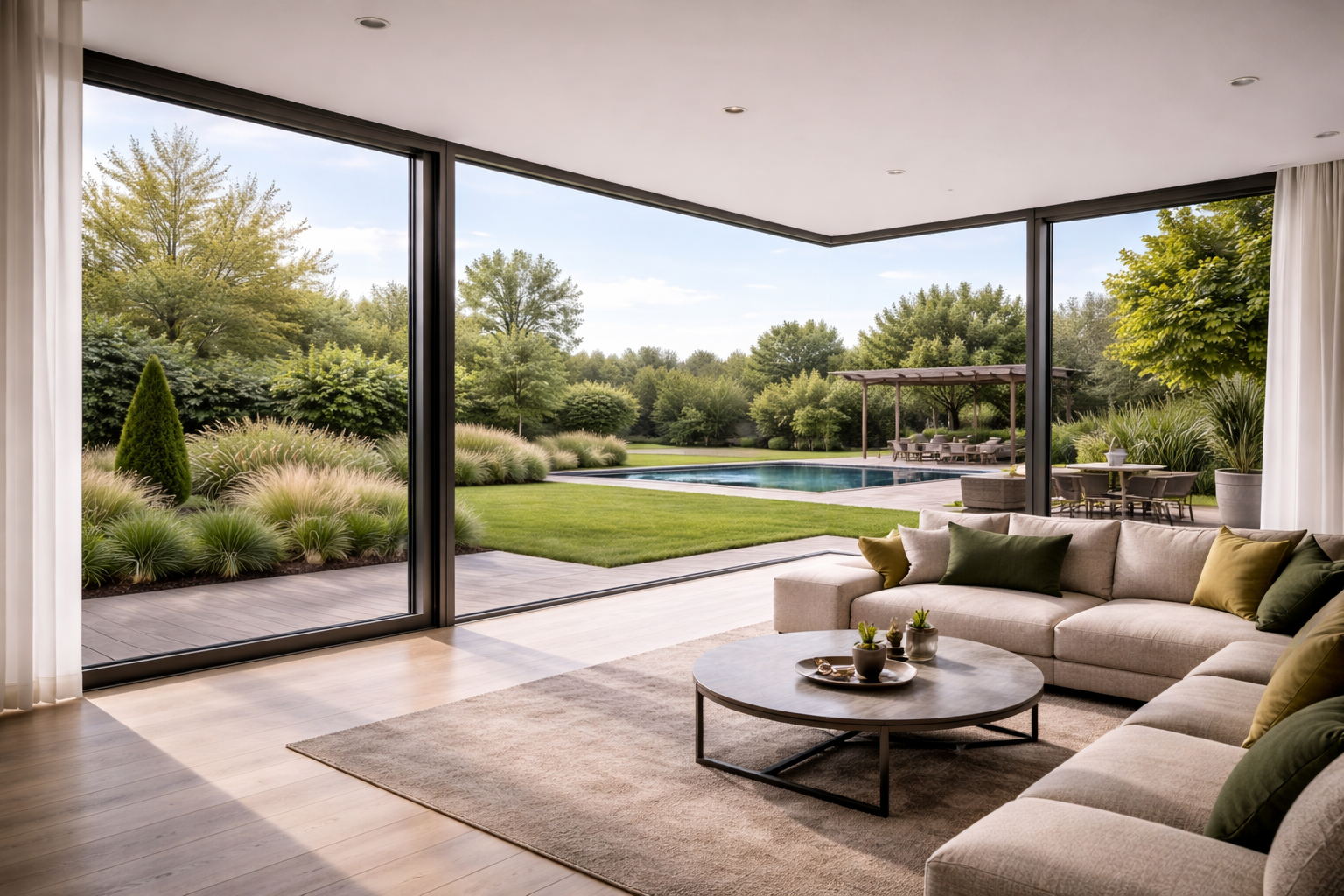
What is a glass corner and why is it changing the architecture of modern homes?
Glass corner, i.e. corner glazing without a mullion, is one of the most advanced and impressive solutions in contemporary window joinery. This technology allows two glass units to be joined at a 90-degree angle without a vertical corner profile, providing an uninterrupted view and maximum interior lighting.
This solution is increasingly used in:
- modern single-family homes,
- premium residences,
- apartments with panoramic views,
- minimalist architectural designs.
Glass corners prove that windows can be a structural element of design, not just a closure for a window opening.
From a technical point of view, a glass corner is a corner connection of two glazing units, most often:
- triple-glazed units with a low Ug coefficient,
- made of tempered and laminated glass (VSG),
- connected using UV structural bonding or special structural silicones.
Depending on the design, the corner can be made in two variants:
- without a mullion – where the glass joins directly at the corner, providing maximum visual effect and an uninterrupted view,
- with a corner mullion – where there is a vertical profile at the point where the panes join, which reinforces the structure and allows the use of opening sashes.
The statics of the entire structure are of key importance here. The absence of a mullion means that:
- the weight of the glass is transferred to the frame profile,
- the lintel must be adequately reinforced,
- the entire structure requires precise calculations of load-bearing capacity and deflection.
Glass corners are most often used in the following configurations:
- FIX + FIX (non-opening windows),
- FIX + system przesuwny HS lub HST
Technical parameters – what matters in corner glazing?
Contrary to appearances, glass corners do not mean a compromise in terms of insulation. Quite the opposite. Modern systems meet the stringent standards of energy-efficient construction.
Key parameters:
- U-value of the entire set – a properly designed glass corner achieves very good values,
- Ug value of the glazing unit – up to 0.5 W/m²K,
- high air and rainwater tightness,
- possibility of using warm spacer bars,
- compatibility with warm layered installation.
This solution will also work well in homes with higher energy standards.
What profiles for glass corners? PVC, aluminium or wood?
The choice of profile system is of great importance not only for the statics and parameters, but also for the visual effect of the glass corner. In practice, corner glazing is made in three main variants: PVC, aluminium and wood.
- Glass corners in aluminium systems are the most common choice in premium projects. Aluminium allows for slim frames, large glazing dimensions and maximum structural stability. Visually, it gives the effect of a modern, minimalist structure, especially with thin profiles and dark colours (e.g. anthracite, black).
- Glass corners in PVC systems are a more economical solution, but still feasible in modern designs. PVC profiles are visually thicker than aluminium, but offer very good thermal parameters and are suitable where energy efficiency and a reasonable budget are priorities.
- Glass corners in wooden or wood-aluminium systems are an option for investors who want to combine modern glazing with a natural, elegant finish. Wood on the inside warms up the interior design and gives a unique visual effect, while the aluminium cover on the outside increases durability and resistance to weather conditions.
The choice of profile material directly affects the aesthetics of the corner, the width of the frames and the possibility of creating large glazing, which is why glass corners should be treated as an element of architectural design and not just a detail of joinery.
Light, space and view – the advantages of glass corners
There is no denying that the biggest advantage of glass corners is daylight. By eliminating the corner post:
- the interior is illuminated from two sides,
- the space seems larger and lighter,
- the boundary between the interior and the surroundings practically disappears.
Glass corners are ideal for:
- open living areas,
- living rooms connected to a terrace,
- corner kitchens,
- modern façades with lots of glass.
This is a solution in which the landscape becomes part of the interior.
Glass corner – a conscious choice in modern window joinery
Glass corner is not a passing trend. It is a consequence of the development of window technology and the growing expectations of investors. Minimalism, light, technical parameters and aesthetics come together here in one point.
Well-designed corner glazing:
- increases the value of the property,
- defines the character of the building,
- provides comfort of use for years to come.
Read also:
Do you have a project with a glass corner or are you looking for a solution?
If you are planning to use a glass corner in your project or are just looking for the best solution for modern corner glazing, please contact our sales representative.
We will help you choose the right option (with or without a mullion), match the profile system and technical parameters to your investment.
Contact us and see what possibilities glass corners offer for your project.
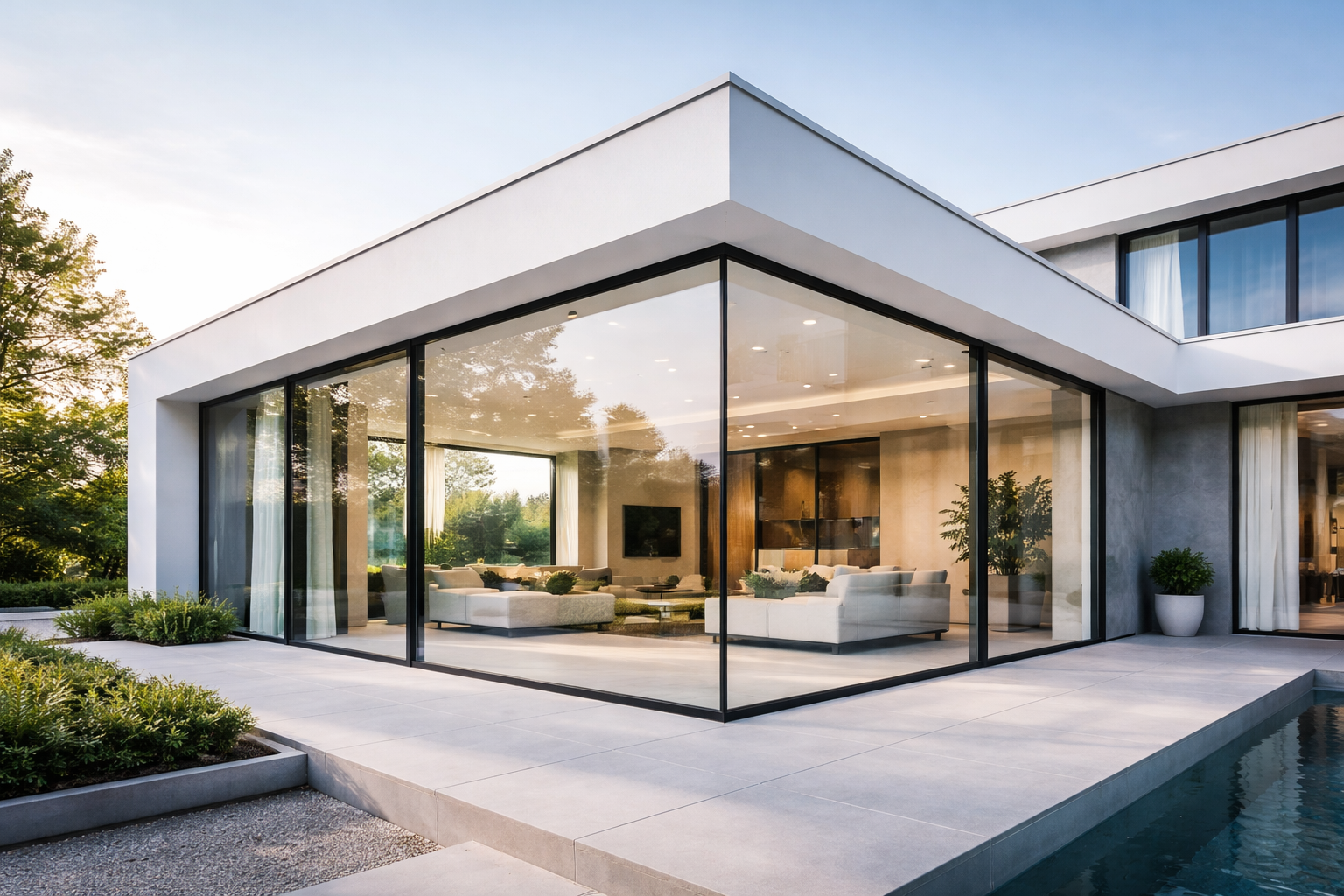
Glass corner with a post
Glass corner with or without a post?
The choice between a glass corner with or without a post depends primarily on the design assumptions and expectations of the investor.
- A glass corner without a post is the most aesthetically pleasing solution – it provides an uninterrupted view, maximum interior lighting and a minimalist visual effect. It is most often used in configurations with FIX fixed windows or in combination with HS/HST sliding systems.
- A glass corner with a mullion offers greater structural stability and the possibility of using opening sashes. This solution is more versatile, easier to install and often chosen where functionality and predictability of technical parameters are key.
In practice, glass corners without a mullion are most often implemented in aluminium systems, which allow for slim frames, high structural rigidity and a minimalist visual effect.
On the other hand, glass corners with a mullion are more often made in PVC or wooden systems, where the presence of a corner profile facilitates stability and allows for the use of opening sashes.
Both variants meet the high standards of modern window joinery — they differ primarily in their scope of application and visual effect.
Do you have a project with a glass corner or are you looking for a solution?
If you are planning to use a glass corner in your project or are just looking for the best solution for modern corner glazing, please contact our sales representative.
We will help you choose the right variant (with or without a mullion), match the profile system and technical parameters to your investment.
Contact us and see what possibilities glass corners offer for your project.