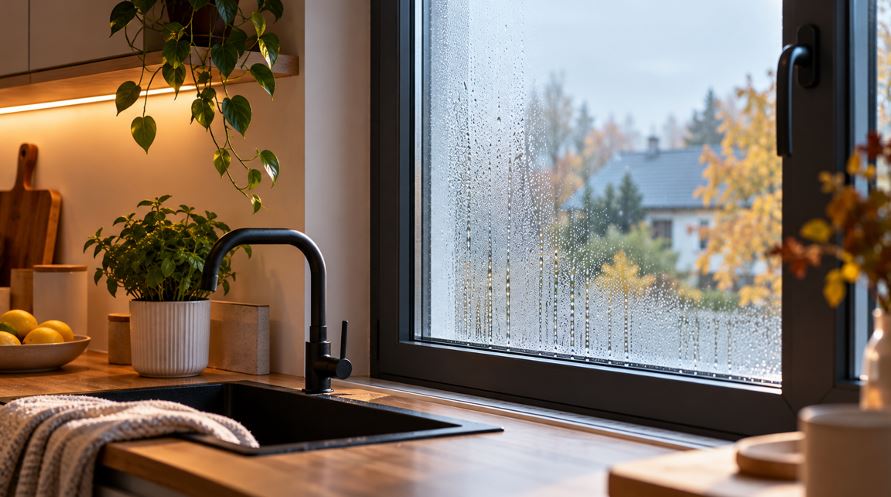
Water droplets appearing on windowpanes, particularly in autumn and winter, are something many homeowners experience. The first reaction is often to worry that the window is not airtight or has been installed incorrectly. However, condensation on windowpanes does not always indicate a problem with the windows themselves. Condensation occurs when water vapour in the air comes into contact with a surface that is sufficiently cold and turns into liquid water. A good example is a bathroom mirror that becomes misted up after a hot shower. A similar process can occur on windows.
The higher the indoor humidity and the colder the glass surface, the more likely condensation is to form. Moisture is produced in our homes every day – through cooking, bathing, drying laundry, cleaning and even breathing. Therefore, a small amount of condensation is not necessarily a cause for concern. However, it is worth observing how often it occurs and where exactly the moisture appears on the window.
Why does condensation appear on windows?
Condensation on the inside – are the windows to blame?
If water droplets appear on the interior surface of the glass, the most common cause is a combination of high indoor humidity and a low glass temperature.
The problem may be particularly noticeable in kitchens, bathrooms and bedrooms. For example, cooking releases a considerable amount of water vapour into the air. If the room is not adequately ventilated, the moisture remains inside and may begin to accumulate on the coldest surfaces.
Interestingly, this phenomenon may become more noticeable after replacing old windows with modern, more airtight models. Older windows often allowed uncontrolled air exchange through various gaps and leaks.
Modern windows are considerably more airtight, making properly functioning building ventilation even more important. Persistent condensation on window panes may therefore be a sign that it is worth checking indoor humidity levels and air circulation rather than immediately assuming that the windows are defective.
See also our articles about:
Condensation on the outside of the glass – a good or bad sign?
Condensation appearing on the outside of the glazing can also come as a surprise to owners of new windows. It is most commonly noticed in the morning, particularly in spring or autumn, when nights are cool and the air is humid. Contrary to what you might expect, this phenomenon may actually be associated with the window's good thermal insulation properties. If the glazing unit effectively reduces heat transfer from inside the building, the outer pane is not significantly warmed by the indoor temperature. As a result, it can remain cold. If its temperature falls below the dew point, moisture in the air begins to condense on the glass surface. This process is similar to dew forming on grass or cars in the morning. It usually disappears naturally as the outdoor temperature rises and does not indicate that the window is leaking. It is therefore important to distinguish between condensation on the exterior surface of the glass and moisture appearing inside the room.
How can you reduce window misting and condensation?
If condensation occurs on the interior surface of the glass, the first step is to look at humidity levels and ventilation in the rooms. Particular attention should be paid to areas where large amounts of water vapour are naturally produced, such as kitchens and bathrooms. When cooking, it is worth using an extractor hood, while after bathing or showering, it is important to ensure that humid air is effectively removed. Regular, short periods of intensive ventilation can also help.
It is worth checking that ventilation grilles are not blocked and that the ventilation system is functioning correctly. If the windows are fitted with trickle vents, they should not remain permanently closed when they form part of the building's intended ventilation system. A simple hygrometer can also be a useful solution, allowing you to monitor the relative humidity indoors. It is also important to avoid drying large amounts of laundry in a closed room without adequate air circulation. Condensation itself is a natural physical phenomenon. The aim is therefore not to eliminate moisture from the home completely, but to maintain the right balance between temperature, humidity and ventilation.
When should condensation on windows be a cause for concern?
Particular attention should be paid when moisture appears between the panes of an insulated glazing unit, rather than on the interior or exterior glass surface. In a properly manufactured and sealed glazing unit, the space between the glass panes is isolated from the air inside the room. If misting appears between the panes and cannot be removed by wiping the glass from either the inside or outside, this may indicate that the glazing unit has lost its seal and requires professional assessment. Another situation that requires attention is when large amounts of water persist on the inside of the window, particularly if moisture begins to accumulate on the frame, window sill or surrounding wall. Over time, this can encourage mould growth and negatively affect indoor conditions. It is therefore worth remembering that not all condensation indicates a problem with the window itself, but its location can tell us a lot about the cause.
At Aikon Distribution, we help customers choose windows with performance characteristics suited to the requirements of their specific projects. The right windows, proper installation and effective building ventilation work together to create a system that helps maintain a comfortable indoor environment and reduce problems associated with excessive moisture.
Write to us!